Trend #3

Information Engineering:

Leveraging the Power of AI at Scale
for Iterative, Adaptive Learning Design

In 2026, AI seems to be everywhere: integrated in Learning Management Systems (LMSs), embedded in productivity tools, and serving up recommendations via streaming services and online shopping platforms.
A full 75% of our people are actively using AI at work to boost their productivity; however, a majority are using unvetted, and possibly unsecured, tools.
Without organizational guardrails, individual employees may inadvertently jeopardize sensitive or proprietary information by entering it into an external AI tool that "learns" it and later passes it on to other users.

A New Paradigm for Learning Development

Despite the risks, AI presents L&D leaders with a golden opportunity to elevate our reputations from that of content provider to learning strategist and architect.

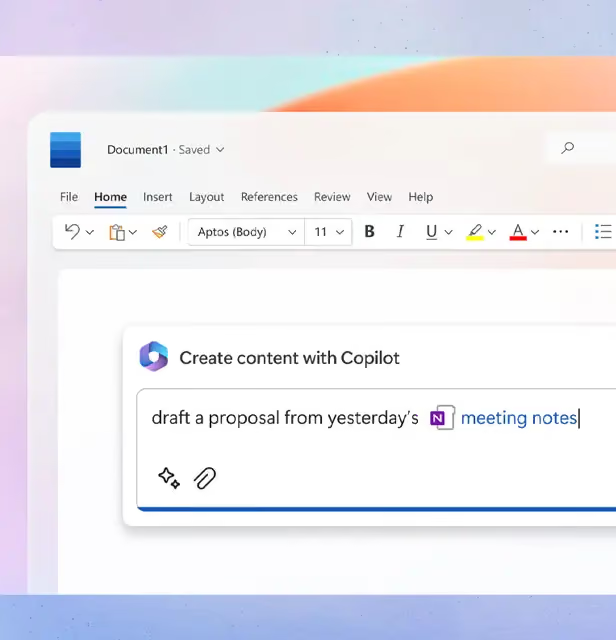
We can leverage in-house AI tools and capabilities—such as Microsoft Copilot, which is used by an estimated 90% of Fortune 500 companies—to create experiences that are more efficient, effective, and engaging for learners.

Thanks to AI, we can leave behind Level 1, click-next eLearning modules and focus on true flow-of-work, adaptive learning that meets learners at real moments of need.

AI’s robust data capabilities empower L&D teams to design for data rather than perpetually chase our “first best guess” about how to meet our organization’s performance needs.

Learning Design:
The Past, Present, and Near Future

Here’s a high-level overview of how AI has fast-tracked the evolution of the learning design and development process.
Past
The waterfall has been our typical process for creating training in our pre-AI world: identifying a performance need, devising a “first best guess” about how to meet the need, developing a range of deliverables, submitting them to clients for detailed reviews, QA testing the solution, and finally rolling it out to learners.

Unfortunately, evaluation was often scrapped due to lack of time, budget, or stakeholder interest.

The challenge with this approach is that it yields discrete, static learning experiences that take a relatively long time to execute, are often disconnected from work, lack continuous reinforcement, and offer few opportunities for learners to get help in the flow of work.
Present and Near Future
Now that AI is in the picture, L&D must adopt a continuous integration/continuous development (CI/CD) process, which requires (and plans for) constant evaluation, adjustment, and iteration.

In this new paradigm, training is no longer a series of one-and-done efforts but a process founded in learning analytics. Designing for and collecting data are must-haves as we seek to refine our learning solutions to address learners’ knowledge and skill gaps.

As always, learners are at the heart of this new paradigm, and they retain their agency over whether, and to what extent, they acquire knowledge, develop skills, and change their behavior. The role of the L&D team, too, remains constant:

We must continue to empower learners with the most effective resources to achieve
these outcomes.

AI can help us by:
Addressing learning needs as they arise in the flow of work
Delivering personalized feedback in response to questions or performance
Adapting learning content to a learner’s skills and knowledge
Monitoring learning experiences for quality
Thanks to these capabilities, AI helps us implement training quickly, then evaluate, adjust,
and iterate based on the analytics it returns.
Though larger, discrete learning initiatives will still meet some of our organizational learning needs,
our portfolios will shift to include more adaptive, flow-of-work learning solutions
powered by context engineering.
Here’s the benefit of context engineering for L&D leaders: We can use it to provide the truly adaptive learning experiences we’ve had on our bucket lists—without the challenges and limitations of the waterfall process.

Curious about how context engineering works?
Get a comprehensive overview of the process and the new types of learning solutions it enables.
Context engineering is a process that acts as an intermediary between external LLMs like ChatGPT, Gemini, or Claude, and our people, this ensures both the security of our organization’s data and delivering relevant, targeted
responses to learners’ queries.

Trends at a Glance

Trend 01
Building Organizational Agility
Learn More
Intro
The L&D Leader in 2026
Learn More
Trend 02
Strategic Staff Expansion
Learn More
Trend 03
Information Engineering
Learn More
Trend 04
Flow-of-Work Conversational Learning
Learn More
Trend 05
The L&D Leader in the Technology Ecosystem
Learn More
Trend 06
Beyond the “First Best Guess"
Learn More
Trend 07
Live Experiential Learning
Learn More
Trend 08
From Points to Purpose
Learn More
Trend 09
Unpromptability at Work
Learn More
Intro
The L&D Leader in 2026
Learn More