



Trend #7

Live Experiential Learning:

Reinforcing Human Connection

If the last few years have taught us anything, it’s that humans crave connection.
Though digital learning has been—and continues to be—a lifeline, learners are increasingly craving live, in-person learning. (Note: Live and in-person does not equal an eight-hour lecture or “death by PowerPoint.”)
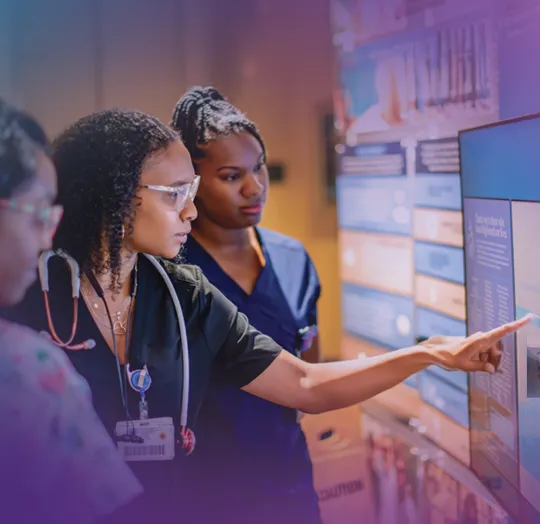
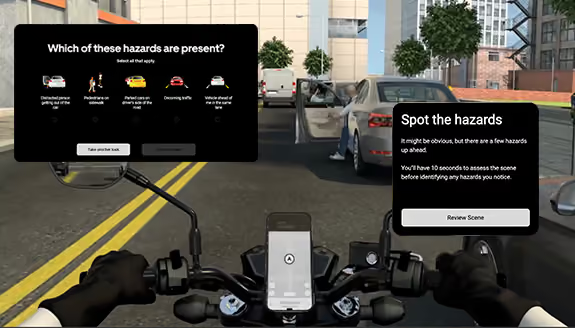
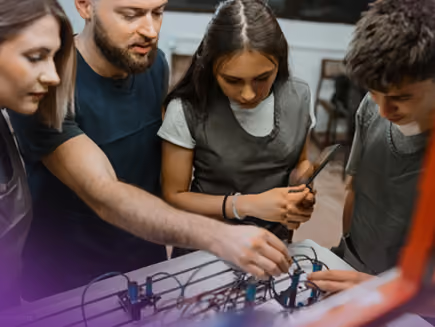
L&D leaders are responding by reimagining instructor-led training (ILT) as Live Experiential Learning (LEL), an immersive, high-energy experience featuring gamification, live simulations, and collaborative challenges that makes learning an event to remember.
LEL is no longer just about imparting knowledge; it’s about building experiential intelligence (XQ), or the attitudes, beliefs, competencies, and abilities that help learners assess, adapt, and respond to nuanced situations in real time.
The Power of Human Connection
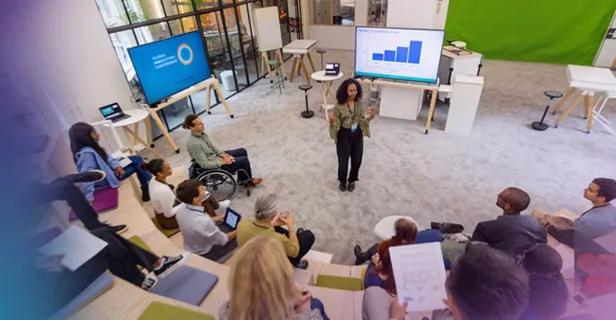
At its core, LEL answers the fundamental human need to belong and connect with others. Whether it unfolds in a brick-and-mortar conference room or a virtual breakout room, LEL helps us build the community and collaboration that holds our teams together.

Like gamification and other forms of learning that replenish screen- and change-fatigued learners,
our people often prefer to learn with others.
01/02
02/02
With social isolation posing a serious risk to people, families, and communities, getting our people together for LEL is an investment in their well-being. Building connection and interaction into our learning and skilling programs help our people build the resilience they need to weather change.
That’s not surprising: Learning itself is inherently social. When we embark on a shared quest or debate a solution in real time, we’re bonding and building trust as we apply our newly acquired skills.

LEL: Immersion > Information Overload

Below is a high-level look at a few best practices to carry with us as we look for opportunities to level up our LEL in 2026 and beyond (Prefer more detail? You’ll find a deeper dive here.):
01

Incorporate small-group learning to help learners process and apply concepts.

02

Establish a foundation of psychological safety.

03

Offer a safe, authentic practice space via simulations or a “sandbox” environment where learners can practice new skills.

04

Leverage AI to generate adaptive simulations that respond to learners’ performance and provide feedback real time.

05

Incorporate ritual, ceremony, and reflection to commemorate the learning journey as a true life event.

The Business = Case:
Why LEL Works

As ever, L&D leaders must demonstrate our responsible stewardship of time, budget, and resources, and—let’s face it—it can be challenging to make a case for LEL when all three are limited.

However, economies can be found within LEL: One way is by leveraging learners’ own work as course material and using their existing skills—for example, as people or project managers—to facilitate group meetings and exchange peer-to-peer learning and coaching. This model is embraced by innovators like Google, where 80% of all training is delivered through a peer-to-peer model.
Benefits of interpersonal connection may be more difficult to trace directly, but engagement and retention are strongly correlated to a robust organizational investment in employee growth.

For example, research by LinkedIn found that
94%
of employees say they would stay longer at an organization that invests in their career development.
With global employee engagement at an all-time low, and organizations are losing out on a collective $438 billion in productivity. Building a robust learning culture is a proven way organizations can demonstrate their care for employees and their interest in their long-term growth…while also growing needed skills in house.
In short: LEL is an optimal modality that serves performance and business needs by serving the human first.
As L&D leaders continue to future-prep our people, we must continue to recommend regular opportunities to connect learners across regions, functions, and roles.

Designing our LEL events and journeys to yield meaningful data will support the business case for LEL and help us design more impactful, connective experiences.

Trends at a Glance

Trend 01
Building Organizational Agility
Learn More
Intro
The L&D Leader in 2026
Learn More
Trend 02
Strategic Staff Expansion
Learn More
Trend 03
Information Engineering
Learn More
Trend 04
Flow-of-Work Conversational Learning
Learn More
Trend 05
The L&D Leader in the Technology Ecosystem
Learn More
Trend 06
Beyond the “First Best Guess"
Learn More
Trend 07
Live Experiential Learning
Learn More
Trend 08
From Points to Purpose
Learn More
Trend 09
Unpromptability at Work
Learn More
Intro
The L&D Leader in 2026
Learn More