Trend #8

From Points to Purpose:

Gamification 2.0

Remember 2017? It was the year "gamification" became an L&D industry buzzword.
Leaderboards popped up everywhere, and badges were sprinkled like confetti across click-next compliance courses.
Unfortunately, just as confetti does not automatically create a party, badges do not necessarily make a game—especially when created as an afterthought to make dry content palatable. After the gamification hype faded, many L&D leaders and teams were left wondering if the investment was worth the effort.
Fast-forward to 2026: 
Gamification is back, but not as a nostalgic reboot.
Gamification 2.0 has leveled up from its former shiny-object status to a technologically sophisticated and strategic engine to boost performance.

Why now? Two events have converged:
A dramatic drop in global workforce engagement
The advent of widely available general artificial intelligence (genAI) tools.
The “Cake-and-Eat-It-Too” Moment
For years, L&D leaders faced a dilemma: We could build richly detailed, authentic simulations, which were costly and time-consuming, or we could produce less-engaging, “click-next” eLearning modules, which were quick and budget-friendly.
Coupled with the exhausting pace of change and economic uncertainty, “quick and budget-friendly” learning has contributed to mounting workplace disengagement and widening skill gaps.
2026 marks our moment to have our cake and eat it, too: AI has shattered this tradeoff and freed us to create the impactful, engaging, and hyper-personalized experiences we’ve been dreaming of—without prohibitive timelines or budgets.
What Defines
Gamification 2.0?
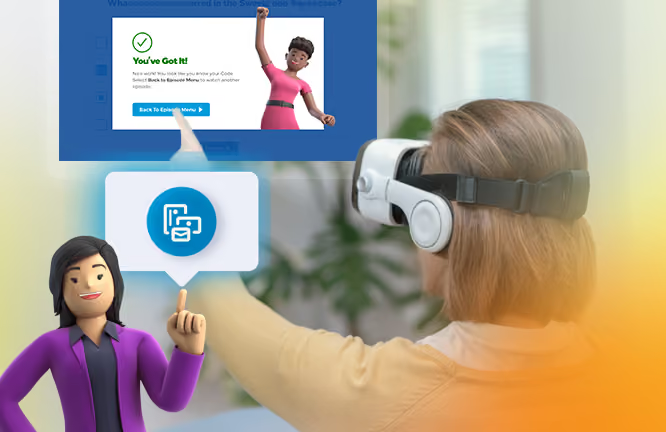
Gamification 2.0 swaps badges and points for intrinsic reward systems, such as personal growth, mastery, purpose, and autonomy.

Instead of tricking people into learning with leaderboards and video-game graphics, gamification is now a strategic approach that respects the learner's intelligence, motivation, and time.
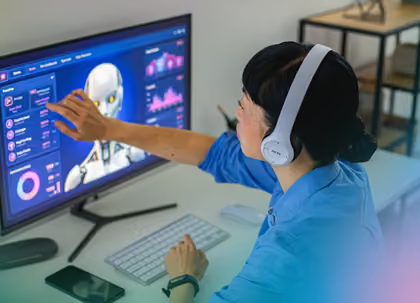
In the past, scenario-based learning typically involved scripted, choose-your-own adventure storylines with only a handful of possible outcomes. Today, AI enables us to draw from a robust organizational knowledge base to create dynamic, interactive gaming simulations that adapt in response to what learners say and do.

Getting Gamification Right in 2026

The resurgence of gamification is good news for L&D leaders looking to reengage their workforce and set a fresh tone for 2026. Here are a few takeaways:
01

Start with the why: Don't add a game to an existing eLearning course. Design the learning experience as a meaningful quest in itself.

02

Design for data: Know the outcomes that matter to your stakeholders, and design your game to measure these data at different points. When you don’t have access to learner performance metrics, in-game performance on authentic tasks are solid stand-ins: “Salespeople who played the negotiation simulation improved their ability to overcome customer objections by 30% and closed deals 15% faster.”)

03

Know your audience: Tailor each game to its target audience. Are players one-person bands who need to be eased into collaborating? A globally distributed group who need to work together to fill customer requests? Do they have a shared interest you might work into the game?

04

Incorporate real-time social gaming: Work is rarely a lone-wolf endeavor. Invoke camaraderie and friendly competition by adding a gamification quest or challenge to a live experiential learning (LEL) event.
Gamification 2.0 is just one example of how L&D leaders might answer the urgent call to drive behavior change, model mindset shifts, and build developmental opportunities into the flow of work.
On a human level, gamification is also a great way to bring fun,
connection, and even humor into the flow of work.
Demonstrating that we care enough about our learners to invest in their growth and enjoyment is a wonderful step L&D leaders can take to rekindle engagement and curiosity in an overwhelmed, change-fatigued workforce. Knowing when to make learning additive, rather than a drain on learners’ attention and bandwidth, is one of the uniquely unpromptable skills that will be most needed in 2026 and beyond.

Trends at a Glance

Trend 01
Building Organizational Agility
Learn More
Intro
The L&D Leader in 2026
Learn More
Trend 02
Strategic Staff Expansion
Learn More
Trend 03
Information Engineering
Learn More
Trend 04
Flow-of-Work Conversational Learning
Learn More
Trend 05
The L&D Leader in the Technology Ecosystem
Learn More
Trend 06
Beyond the “First Best Guess"
Learn More
Trend 07
Live Experiential Learning
Learn More
Trend 08
From Points to Purpose
Learn More
Trend 09
Unpromptability at Work
Learn More
Intro
The L&D Leader in 2026
Learn More