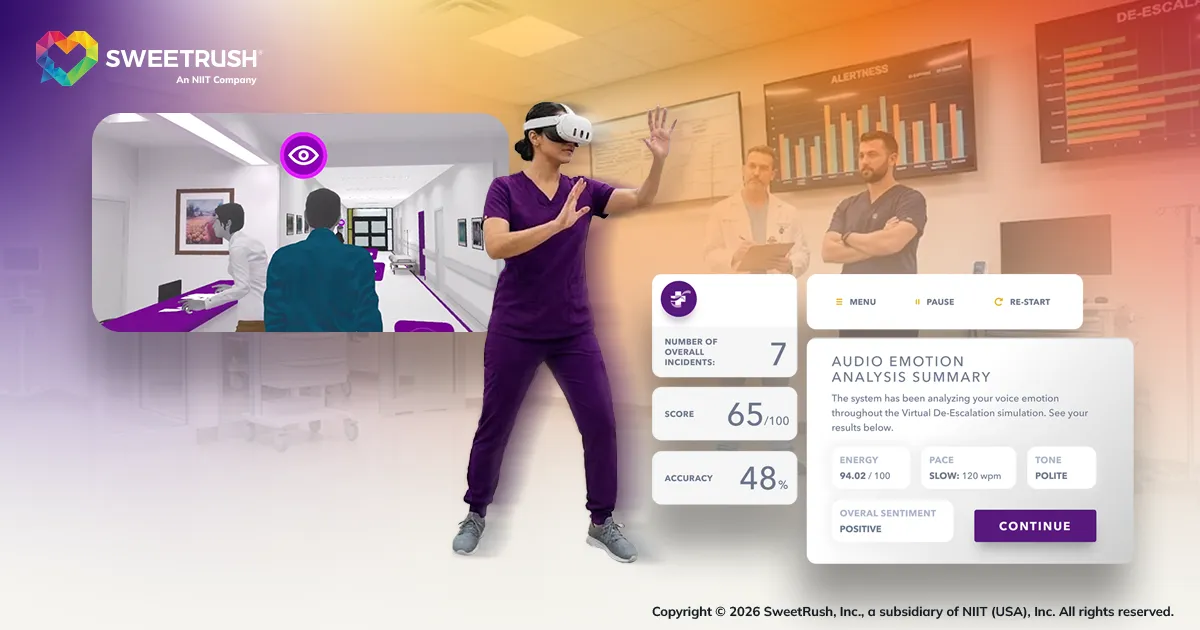

No one should have to worry about injury due to violence in the workplace. But for healthcare providers, the risk is all too real…and it’s on the rise. Its repercussions are not only financial, but psychological and emotional—and they affect healthcare employee retention and recruitment and patient confidence.


of U.S. healthcare workers have reported experiencing violence (Yosep et al, 2023).

of U.S. nurses report being assaulted by a patient or family member (Joint Commission International, 2021.)

of all workplace injuries due to violence affect healthcare workers (Lim et al, 2022).

The total annual financial cost of violence to hospitals
Hospitals and health care centers are uniquely vulnerable because they generally offer unrestricted public access in an often-tense environment. When patients or family members respond to stress with aggressive behavior or language, healthcare providers need to identify the risks, think—and act—quickly to defuse the situations.
How can we train thousands of healthcare providers to de-escalate dangerous situations without placing them in danger?
That was exactly the question we set out to solve with our client-partners at a major regional healthcare system.
Discover how our client-partner created a zero-risk VR environment that puts healthcare providers face-to-face with real pressure in three high-adrenaline patient scenarios.

Their existing, live instructor-led classroom training was high-quality but difficult to scale for a learner audience of over 45,000 healthcare providers.
Our client was on the right track by offering learners a safe classroom environment to role-play their reactions to these tense situations. However, classroom-based role-play didn't evoke the strong emotions learners must experience to effectively prepare and practice for real-life situations.
Learners needed a practice space that offers safety and challenges them to act with urgency and immediacy.
Together, we decided to bring the role-play experience closer to the real-life environments where learners are most likely to be the targets of patient aggression: for example, a hospital room or an open reception area.
Classroom role-plays can’t replicate the heart-pounding immediacy of a face-to-face confrontation. Discover how our client scaled an immersive masterclass in de-escalation and self-defense to 45,000+ healthcare providers.
Hands-on application is the best way to learn a skill—and fully immersive virtual reality (VR) training is the closest thing to the real world. It’s a great modality to prepare learners to respond to situations that are dangerous, impossible, counterproductive, or expensive (Bailenson, 2018) and thus wouldn’t want to recreate in real life. Our client-partner’s need for de-escalation of dangerous situations was a perfect use case.
The more learners we reach, the greater the return on investment of our VR solutions: A recent study by PwC found that VR training is more cost-effective at scale than traditional classroom or eLearning experiences.
(Likens and Mower for PwC, 2022)
Delve into the details of this immersive masterclass in de-escalation, alertness, and self-defense in the hospital setting risk—and why it works—with the complete case study.



Connect with our industry experts on the subjects that matter most to you.
SweetRush delivers innovative learning and development solutions, including custom eLearning, immersive training, and talent development strategies.


