
We all aspire to be a high performer—or even a better high performer! This interview series is for you and intended to help you on your professional journey. Each month, we interview a high performer in a different industry to shed light on what it takes to excel in life and in a professional career. Our reputation in the industry is built on high-performance, and our Talent Agency’s focus is on placing high performers with our clients. So, cheers to high-performance!
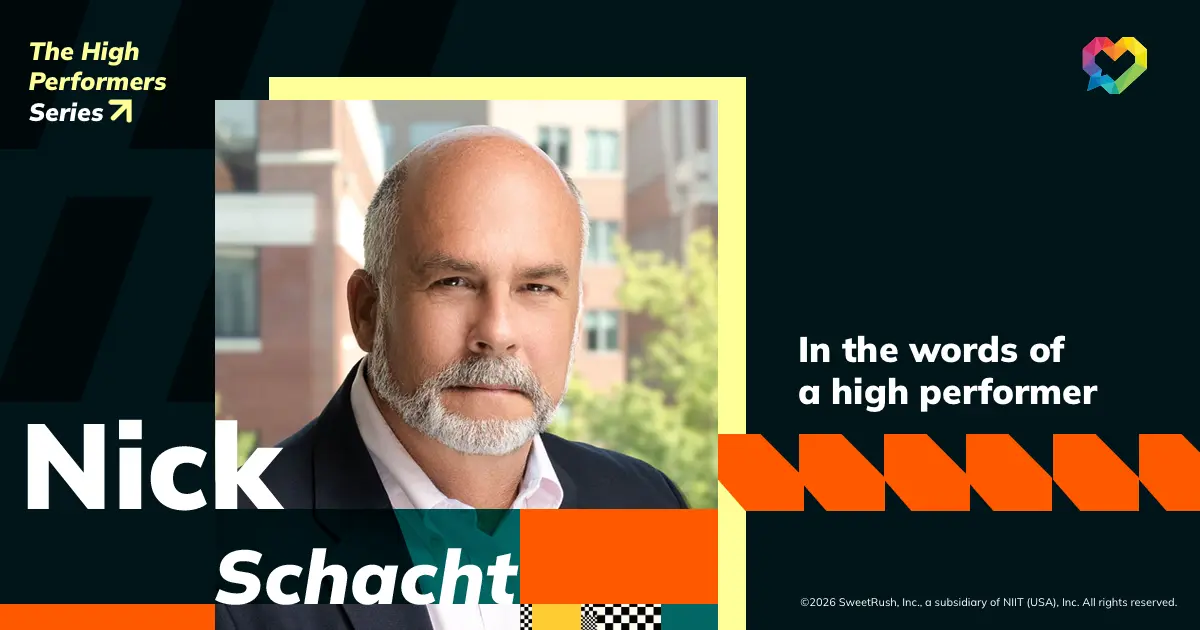
This month’s interview with Nick Schacht was hosted by SweetRush Cofounder Arturo Schwartzberg.
Nick Schacht has had a long and illustrious leadership career in L&D and, most recently, was the Chief Commercial Officer at The Society for Human Resource Management (SHRM). A seasoned executive, Nick has previously served as president and CEO for numerous organizations, including Learning Tree International; PetroSkills, a petroleum engineering training company, and a cybersecurity training firm.
Nick’s career is founded in service, beginning with his studies in the U.S. Naval Academy and tenure in the U.S. Navy’s nuclear propulsion program. His unshakeable work ethic was forged early and fueled by his perpetual curiosity and refusal to say “That’s not my job.”
In the following conversation, Nick shares his unique insights on what makes a high performer, diving into the importance of curiosity, team success, and lifelong impact.
Arturo: To start, I would like to hear about your life journey and what superpowers have enabled you to be successful.
Nick: I started my career in the Navy and attended the U.S. Naval Academy. Before that, I did all kinds of things: delivering newspapers at five in the morning, painting houses, and mowing lawns, as well as going to school, of course.
After the Navy, I became the 20th employee at a small training company where I learned everything from teaching and designing classes to reproducing materials. I eventually became president and then ran several other companies, including Learning Tree International, a petroleum engineering training company, and a cybersecurity training company. I most recently spent nine years at SHRM as the Chief Commercial Officer.
The things that enabled me were curiosity, a desire to learn, and never uttering the phrase, “That’s not my job.” I filled vacuums, chased opportunities, and was not afraid to make mistakes because you learn from them.
“The things that enabled me were curiosity, a desire to learn, and never uttering the phrase, ‘That’s not my job.’ I filled vacuums, chased opportunities, and was not afraid to make mistakes because you learn from them.”—Nick Schacht
Arturo: I love that you never say something is not your job. That mindset of excelling at whatever job is in front of you is a key attribute of a high performer.
“The mindset of excelling at whatever job is in front of you is a key attribute of a high performer.”—Arturo Schwartzberg
Nick: It keeps you from missing opportunities and chances to hone skills. For example, when I was a kid, my parents managed a campground in the summer. One of my jobs was collecting trash in the hot Connecticut summer. You could do it well by carefully lifting the bags to avoid spills and then cleaning up small pieces, or you could do it carelessly and fast, which often resulted in more cleanup. Doing that job also developed my empathy and respect for people who do those types of jobs.
Arturo: We created an immersive experience for Hilton about a day in the life of a housekeeper, and I developed similar empathy for them. Where did your motivation come from? Was it cultural, from your parents, or self-generated?
Nick: It was a combination. Growing up in the ‘60s, it was a cultural norm for children to do those types of things. My father was a public-school teacher, and I was the oldest of four kids, so there was not a lot of extra money. If you wanted spending money, you had to figure out how to make it.
Arturo: What behavioral trait do you think held you back or was something you had to overcome?
Nick: Probably not relying enough on other people. I tried to do everything myself instead of working through a team. I only have the bandwidth of one person, and until I learned to effectively leverage and combine the abilities of others, I was hamstringing myself. It was a realization that happened over time. I was more of an introvert, but as I consciously developed the ability to work with others, I appreciated what we could do together compared to what I could do myself.
I still have to practice this today. We are born with a preferred behavioral set, but we can learn other behaviors. For example, meeting and talking to new people did not come naturally to me. I set a routine to have conversations with at least five people I did not know whenever I was in a social setting. It was awkward at first, but I got better, and I still practice it, because sometimes I can fall prey to that introverted desire to just be by myself.
Arturo: That’s interesting, because one would not know that about you in social or business settings. It reminds me of the book The Man Who Ate Everything, where a food critic had to force himself to eat things he did not like until he got over it.
Arturo: Ethiopian runner Yomif Kejelcha recently ran a marathon in under two hours, which is an extreme manifestation of human high performance. When you think of a high performer, who comes to mind?
Nick: Yogi Berra. He was an all-star Major League Baseball player for 15 seasons in a row. As a player, he played in 15 World Series and won 10, which was more than anyone else. As a coach, he was in eight more World Series, and his teams won three. He was an MVP three times. He was a first-generation son of an Italian immigrant who spent two years in the Army at Omaha and Utah Beaches during World War II before his 40-plus-year baseball career.
He was amazing individually, but he was also the reason his teams were amazing. One of my favorite “Yogi-isms” is: “Nobody comes here anymore. It’s too crowded.”
Arturo: In the world of L&D, we hope to change lives and behavior. Do you think everyone has the potential to be, or can be taught to be, a high performer?
Nick: Not necessarily everyone has the potential, but people can be put in situations and learn things that increase the likelihood of being a high performer. High performance has two dimensions: what you can actually do—your skills—and bringing out the best in the people around you. For example, I will never be a marathon runner because I am not built that way, but I could improve my performance.
To me, true high performance is determined by how one impacts the team. We leverage our own performance through others. In organizations, everything has to do with teams. The best high performers are the ones who get the most out of the teams.
Arturo: I agree that the most valued high performer is the one who also lifts up the team; those people become leaders. I have worked with high performers who are visionaries but not necessarily great lifters of the team, and I try to help them broaden their abilities to become leaders.
Nick: If you are a visionary but cannot inspire people, you will have a hard time getting a lot done.
Arturo: Have you ever been surprised by someone’s growing into a high performer? I’ve seen instances where a leader leaves, and the person under them suddenly flourishes, like a shade tree has been removed.
Nick: Yes. Often, it is about an environmental change. I once hired a person who was top of their class at Berkeley and Harvard Law but struggled in program management roles. When I made them our in-house legal and contracts manager, their performance became exceptional, and they significantly increased our growth rate. Sometimes you just need to find the “keystone.”
Arturo: As a leader looking to help people excel, do you often ask yourself if people are in the right position?
Nick: I look at that when there are inefficiencies, but even when things are going well, I ask how to prepare people for their next role, even if it’s not in my organization. Doing so creates a virtuous learning cycle. A garden’s beauty is in how it changes through pruning and replanting, not in sameness.
Arturo: Edison famously said genius is 1% inspiration and 99% hard work. Do you think high performers work harder, are more focused, or are smarter?
Nick: Intelligence gives you a potential head start, but the common characteristic of high performers is that they are never absolutely satisfied. They are always curious and want to be better tomorrow than they are today. They ask why things work or don’t work—and how they could work differently.
“...The common characteristic of high performers is that they are never absolutely satisfied. They are always curious and want to be better tomorrow than they are today. They ask why things work or don't work—and how they could work differently.”—Nick Schacht
Arturo: I agree. Even among a group of good people, some stand out for their level of will and striving for excellence.
Nick: And the next time around, they are looking to make it even better than before. They don’t have to be in a leadership position to drive the whole group forward.
Arturo: I’ve found high performers think about how their job will affect others. In construction, there’s a difference between a carpenter who leaves gaps for the painter to fix and one who strives for excellence.
Arturo: Whose responsibility is it to enable people to be the best they can be—parents, teachers, business leaders, or the government?
Nick: It starts with parents as a child’s first teachers. We can instill principles like asking “why,” stepping in to help, and playing well with others from a very small age. This should then be carried forward in schools and workplaces. It is a multi-layered societal responsibility.
Arturo: I agree. And I wish we had more funding and appreciation for teachers, given the time our kids spend with them. If a parent asked you for advice on instilling values for success, what would you say?
Nick: Help your child discover and develop their natural strengths and learn how to be good at something. Give them opportunities to accomplish things with other people, whether through a soccer team, a doubles partner in tennis, or drama. They will learn how what they are good at matters and how they can help bring out what others are good at.
Advice to parents: “Help your child discover and develop their natural strengths and learn how to be good at something. Give them opportunities to accomplish things with other people, whether through a soccer team, a doubles partner in tennis, or drama. They will learn how what they are good at matters and how they can help bring out what others are good at.”—Nick Schacht
Arturo: That’s insightful. Helping children lean into their unique superpowers is important because we all suffer trying to do things we are not good at.
Arturo: Do you think high performers also need to embrace strategic thinking to add value?
Nick: Some do, so organizations function strategically, but you also need tactical thinkers and people who do the work. You need high-functioning organizers and executors to have a fully capable team.
Arturo: Again, I agree, and having the right balance between strategic thinkers and those who get stuff done is critical. Regarding AI and the transformation we are experiencing, what is your advice to young people entering the workforce?
Nick: Be as curious as possible and constantly ask “what if?” Explore tools like AI to see how they can leverage them to drive their abilities further. AI is not artificial intelligence; it is “amplified intelligence.” It is an amplifier for human intelligence, much like a microphone amplifies a voice to fill a stadium. But you only get that if you are curious and explore what it can do.
Advice to young people entering the workforce: “Explore tools like AI to see how they can leverage them to drive their abilities further. AI is not artificial intelligence; it is ‘amplified intelligence.’ It is an amplifier for human intelligence, much like a microphone amplifies a voice to fill a stadium.”—Nick Schacht
Arturo: I have a love-hate relationship with AI. I wonder about the skills that will atrophy, similar to how now with computers we’ve lost the ability to do many things, for example long division or writing by hand.
Nick: That is just how humans change. We have vestigial tails that we don’t need for balance anymore. This has been one person’s perspective; there are as many perspectives as there are conversations, and no single right answer.
Arturo: Thank you, Nick. I think I can say our thing here at SweetRush is all about high performance and your insights have been invaluable…so thank you. I’m thrilled we’ve had this opportunity to connect.
Nick: Thank you, Arturo. Take care.



Connect with our industry experts on the subjects that matter most to you.


SweetRush delivers innovative learning and development solutions, including custom eLearning, immersive training, and talent development strategies.


