
At their live ATD 2026 session, in-house experts Carla Torgerson and John Cleave shared practical approaches to AI microlearning, sharing its value as a partner for developing engaging, personalized learning content. They also delved into the back-end analytics opportunities that offer L&D leaders and teams insights they can use to course-correct and maximize personalization, learner experience (LX), and value.
As always, the live audience asked a lot of incisive, in-depth questions…and we’re continuing the conversation below. Read on for Carla’s and John’s answers to the most pressing (and current) questions about AI simulations, video tools, and content creation.
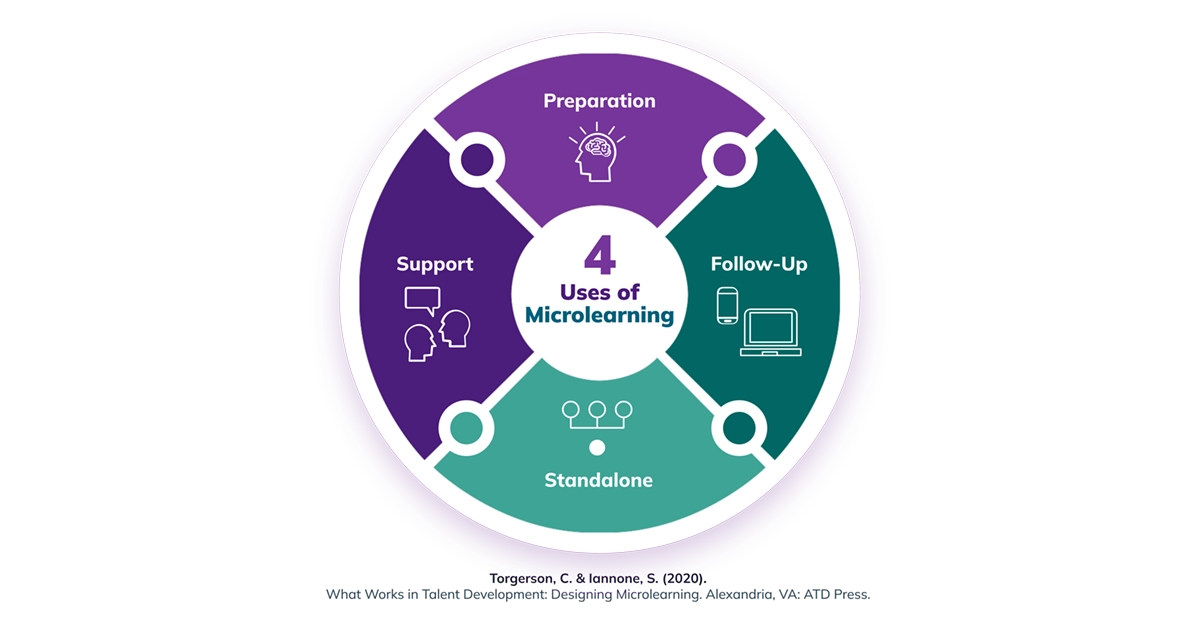
Carla’s model identifies four situations that warrant the use of microlearning:
Often, we’ve found that a blend of longer training and microlearning work well: for example, longer training to dive into a topic, then microlearning to reinforce afterwards. Also, when learners are performing a task, microlearning can be invaluable for quick reference to revisit a term, concept, or steps in a process.
Feedback comes up once the learner submits a response. Feedback is provided after each interaction with the guest, rather than holding it until the end of the interaction. Although different design choices are possible, we like this one because it allows the learner to use the coaching feedback to course-correct.
How are you making the development of these dynamic or static AI microlearning building blocks scalable across all of your developers? Are you building a skill.md repository?
We built a middle layer, or Retrieval-Augmented Generation (RAG), to which the module sends the learner’s text input. This middle layer couples the text input with instructions about the customer service model we use and what to look for in the learner’s response. It then sends both to a commercial LLM, which processes it based on a prompt and returns the character’s response and feedback. By using a middle layer, multiple developers can create different modules and scenarios, and we can maintain consistent performance by the AI across them without developers having to worry about the details. This facilitates scaling and rapid development.
In this simulation, there was also a mock chat app. When developing sims of actual apps like that, are you finding more success working hand in hand with software engineers and product folks to get them to assist directly on the learning-side development, or do your learning developers just use prototypes and have AI generate a facsimile?
We design and build a front end and work with engineers, learning experience designers, and the client to develop the RAG (as mentioned above, the RAG includes an explanation of the model and what specific things to look for in a learner’s input), as well as the context and prompt engineering. We built the front end by hand—that is, we did not use AI to prototype or create it—though in the future, building it with AI may become a viable approach.
We have seen an ability to offer levels of video quality that weren’t previously affordable for some clients. For example, we use AI tools like HeyGen to add lifelike avatars to our courses. Using avatars provides a flexible, scalable alternative to full studio shoots, allowing us to offer this premium feature at no additional cost with our standard eLearning courses.
For complex, realistic action videos, AI helps us streamline the heavy logistical burdens of traditional production, making it accessible to L&D where it used to be unrealistic due to the cost of such a video shoot. We can now produce high-end, complex content in-house with greater agility, faster turnaround times, and at a more affordable cost than ever before.
We typically don’t work with a custom LLM; we use one of the commercial LLMs and provide it with information about the organization, learning need, and whatever behavioral model is being taught so that it returns productive responses. Typically, to ensure that the LLM always returns a response that is aligned with the culture and norms of the organization, we use thoughtful context engineering and careful prompting to get the desired results. We also perform thorough quality assurance (QA) testing it around the edges” to make sure it gets things right, even with unusual examples. The better that we can spell out what “correct” means—for example, by explaining what we seek, providing examples of what to look for—the higher the probability of success. We can also provide the LLM with instructions about what is considered appropriate and inappropriate responses, which helps to establish guardrails around the activity.
Wow, that’s a tough one. What this says to us is, perhaps he doesn’t recognize the value of microlearning or, at least, the specific microlearning you’re recommending. Perhaps you can make a case about its value to get him on board. Point out that microlearning is more convenient to learners, can help reinforce prior training (to keep it top of mind), and offers more flexibility (in that it can be mixed and matched differently for different audiences).
You might also inquire as to why he hasn’t embraced it. It could be that he feels, because it’s more brief, it has less value than standard training, which simply isn’t true if the microlearning is well-designed. Alternatively, you could do some user testing: Ask a few of your target learners if they would find the microlearning content useful. If they do, report this to your boss.
One of the first steps we recommend is identifying where microlearning can be beneficial, using Carla’s model of the four common use cases (explained and illustrated in Question 1).
Knowing what you need will help you better identify the necessary resources and give you something to discuss with candidates during interviews.
In terms of the candidate profile, we recommend looking for an instructional designer who is proficient in an eLearning authoring tool such as Articulate Rise or Storyline, or other tools your organization might use, and has some experience building eLearning or microlearning. Depending on your organization’s learning needs, a simple document or PDF might suffice as a microlearning modality.
7. Knowing that GenAI is a sycophant, how do we ensure the AI tool is giving sound feedback and not incorrectly praising the learner?
The feedback criteria and format need to be spelled out in the information provided to GenAI before it does its assessment. By telling it to identify mistakes and misapplications of a model, and offering examples of what to look for, you can avoid having it offer praise that isn’t warranted. It should also know that, when someone does something good, it should point that out, so it doesn’t come across as overly negative. Feedback quality really does come down to the prompts you feed the LLM.
8. How do I integrate microlearning using AI into my current development programs and LMS?
There are a number of ways to incorporate AI into your microlearning:
In our ATD2026 session, we suggested considering the following key items when conducting your analysis:
We also created questions you can ask yourself and provided a job aid (click to download).
9. Is it worthwhile to purchase a solution off the shelf rather than building it in-house with Gen-AI?
With off-the-shelf solutions growing daily, it makes sense to explore this space first: You may be able to find a solution more quickly, and with less development effort. However, the tradeoff is that it may not be exactly what you need, and it could become pricey as usage grows. So, an alternative is to create your own solution: This option takes more development effort but gives you greater control over the learning experience, and may ultimately cost less than purchasing an off-the-shelf solution. So, it really boils down to whether there’s an off-the-shelf solution that does what you need affordably: if so, that’s likely a better choice. Otherwise, build your own.
10. Articulate, Synthesia, or both—and why?
Synthesia is great for creating realistic avatars and “talking head” videos, though many L&D leaders have questioned the instructional value of using too much of this form of learning. We've also found it to be fairly pricey. To be fair, it has great value, but we recommend it be used in short pieces.
Articulate Rise and Storyline allow you to create eLearning modules, and have AI features that will help you to generate content.
So we’d say, if you just want video, look at Synthesia (or HeyGen, Veed, Google Veo, or any number of other AI video tools). However, if you seek to create eLearning, Articulate is your best bet. You can also create videos with those AI video tools, and then use them in the eLearning—which combines the best of both worlds.
That wraps up the questions shared by the live audience, but the conversation is far from over. Our opportunities to harness AI’s personalization, content creation, and analytics superpowers for L&D are picking up speed.
Whether you're looking to scale your team through AI-human partnerships or add adrenaline-inducing AI-powered simulations to your learning portfolio, you're not on this journey alone.
If you’ve got a question of your own about AI-powered microlearning—or an experience, insight, or inspiration to share—we’d love to hear from you. Reach out to our team to explore ways to turn your curiosity into action…and lasting impact.



.webp)
Connect with our industry experts on the subjects that matter most to you.



SweetRush delivers innovative learning and development solutions, including custom eLearning, immersive training, and talent development strategies.


