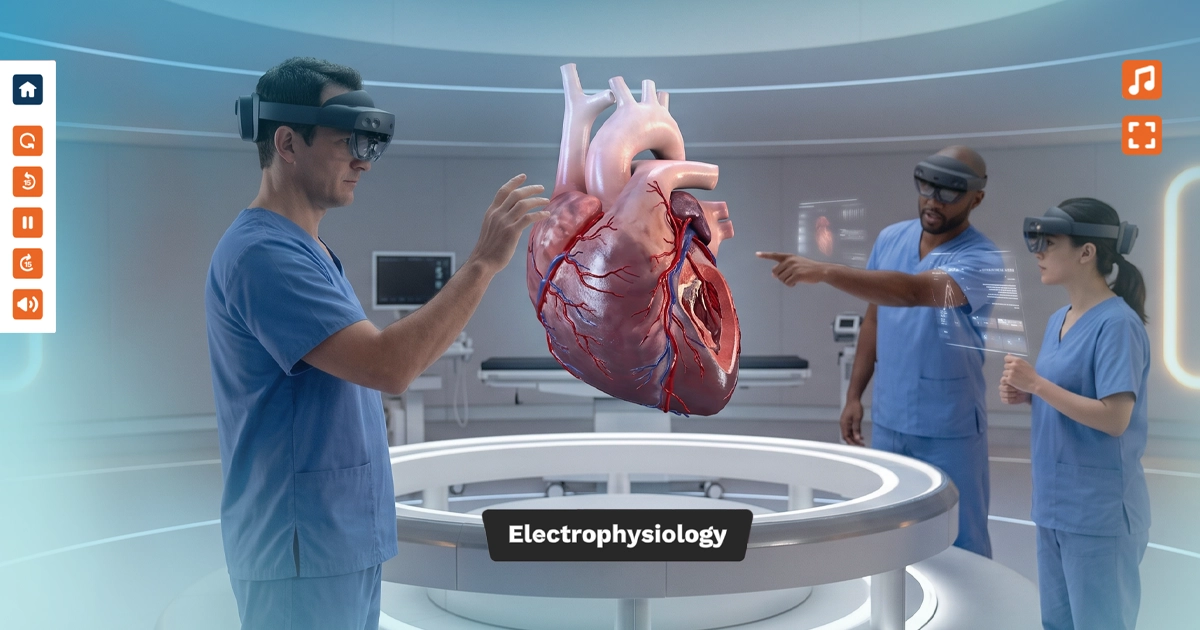

The human heart isn’t just a cute emoji; it’s a leading indicator of a patient's overall health. When there’s an issue, a physician’s ability to interpret electrocardiogram (ECG) findings swiftly and accurately is nothing short of life-saving.
To help its 130,000+ members improve these vital skills, the American Association of Family Physicians (AAFP) brings cardiac conditions vividly to life in a virtual reality (VR) encounter with a simulation of a beating human heart. Through hyper-realistic 3D graphics and spatial audio, cardiac irregularities unfold in real time—and learners rotate, zoom into, and examine the structure and function of the simulated heart. As they do so, learners construct a working mental model of cardiac anatomy and electrical pathways, bridging the gap between abstract two-dimensional ECG data and real-world cardiac health.
130,000+ family physicians, residents, and medical students across all 50 U.S. states

There’s no question that reading an electrocardiogram (ECG) correctly is a critical skill. For a family physician, it can mean the difference between a swift, life-saving intervention and a delayed or missed diagnosis.
Traditional ECG education, however, relied on flat, two-dimensional charts, case examples, and lengthy presentation decks delivered via traditional instructor-led training (ILT) sessions. Learners expressed difficulty translating two-dimensional ECG data into a three-dimensional understanding of heart function—much less applying that insight consistently at the point of care.
The learning need was clear: Family physicians needed to practice their ECG reading and interpretation skills. But these skills, like many hands-on, high-stakes skills, are best learned by doing.
Yet hands-on practice requires a process of trial, error, feedback, and reflection—and there’s simply no room for error with real-life heart patients.
The AAFP-SweetRush team faced a classic catch-22: It needed to find a way to provide hands-on, experiential training in ECG interpretation and diagnosis to physicians, residents, and medical students without risking the health or well-being of real patients.
The team, already well-versed in creating engaging, impactful experiential learning solutions, had uncovered another use case for immersive simulations.
Enter the AAFP-SweetRush team’s answer to the gap between abstract theory and clinical practice: the AAFP ECG VR Experience. This high-fidelity immersive simulation invites learners on a journey into the human heart. Instead of studying ECG patterns as flat lines on a page, learners watch them play out in real time as they explore a 20:1-scale simulation of a beating human heart.
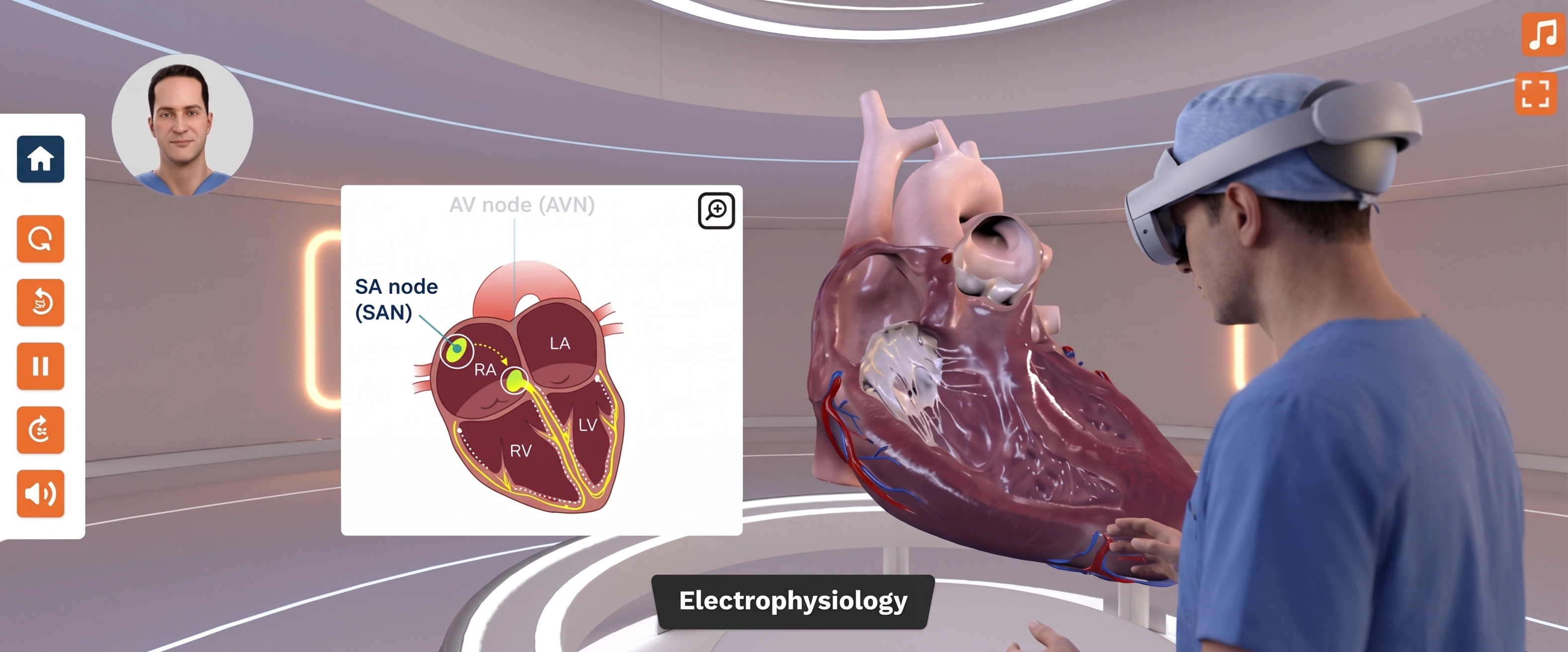
Delve into the heart of the experience and how it unfolds for learners in both the live, instructor-led training (ILT) and on-demand virtual learning versions.

Through spatial audio, hyper-realistic 3D graphics, and detailed heart behaviors, cardiac case studies become visible, explorable, and memorable. The learner can rotate, zoom in, and investigate the simulated heart, connecting two-dimensional ECG results to what’s really happening inside the patient’s body.
Depending on their level of skill (and confidence), learners might enter the AAFP ECG VR Experience at either a foundational or advanced level.
At both levels, learners will develop the following mission-critical competencies:
Learners develop these competencies via a highly structured learning journey that moves through three phases.
Discover how this awe-inspiring immersive experience bridges the gap between 2D data and 3D cardiac anatomy.


.avif)
Connect with our industry experts on the subjects that matter most to you.
SweetRush delivers innovative learning and development solutions, including custom eLearning, immersive training, and talent development strategies.


