
We all aspire to be a high performer—or even a better high performer! This interview series is for you and intended to help you on your professional journey. Each month, we interview a high performer in a different industry to shed light on what it takes to excel in life and in a professional career. Our reputation in the industry is built on high performance, and our Talent Agency’s focus is on placing high performers with our clients. So, cheers to high performance!
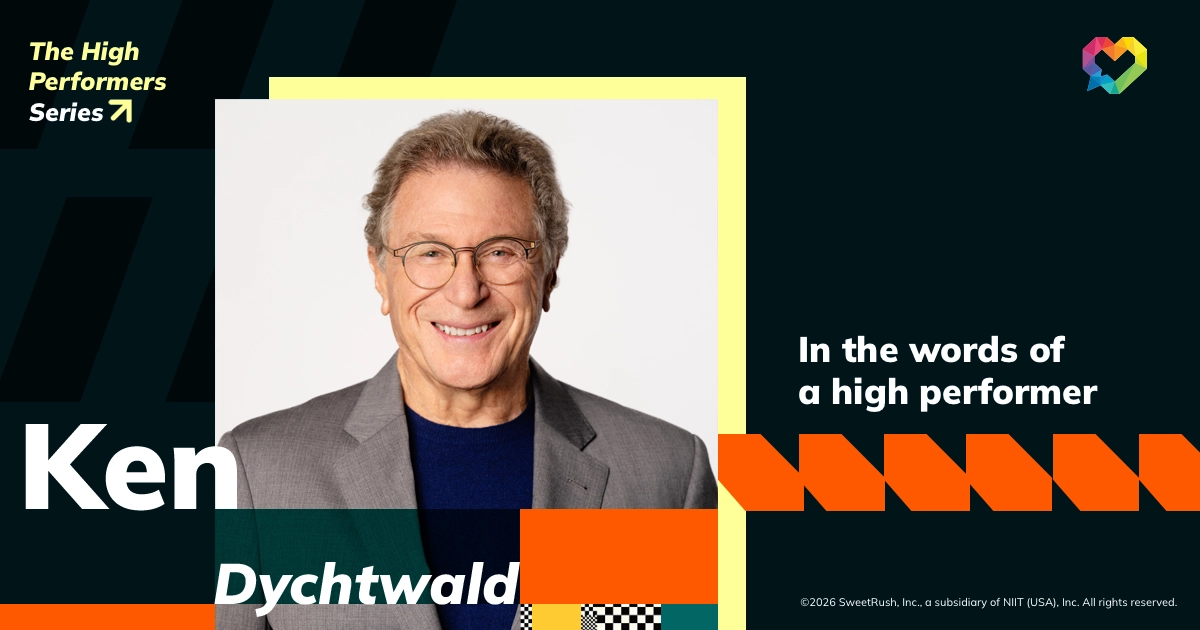
This month’s interview with Ken Dychtwald was hosted by SweetRush Cofounder Arturo Schwartzberg.
Dr. Ken Dychtwald has spent over five decades studying human behavior, longevity, and the shifting demographics of the “age wave.“ His journey began at the Esalen Institute, where he explored the intersection of psychology and physiology, publishing his first enduring book, Bodymind, in his twenties. A few years later, Ken founded Age Wave, the world’s leading organization focused on longevity, aging, retirement, and the economic power of the 50+ population in 1986.
Ken is an acclaimed thought leader in his field, having addressed a combined audience of over two million, served on nonpartisan congressional task forces, and consulted for over half of the Fortune 500 list. He has earned numerous industry recognitions for his work on active aging.
Ken is driven by an intrinsic “radical curiosity” and feels a strong responsibility to make a meaningful and lasting impact on society. In the following interview, he discusses his life journey and the role “never being content“ has played in his success.
Arturo: Greetings Ken, and thank you for stepping up to share your thoughts on being a high performer. To get going, I’d love to hear, in your words, about your life journey and the superpowers that have enabled you to be successful in your career and life.
Ken: Well, I grew up as kind of a plain-vanilla kid in Newark, New Jersey. Neither of my parents had been to college. They were hardworking, good people, but not very worldly.
I did very well in high school, near the top of my class, and I was told that I was a math prodigy. So, I went off to college to become a physicist. Did I want to be a physicist? I didn’t really know. Who knows at that age? I don’t know that anybody, when they’re a teenager, has the vaguest idea what they really have in front of them or who they are.
In any case, I went to a fine little engineering school—Lehigh, in Pennsylvania—and was on my way to becoming a physicist. In my junior year, I had to take a social sciences course, so I took a psychology class. At that time, 1968-ish, I had no idea what psychology even was.
The professor grew up in Brooklyn, but he got his doctorate at Stanford. So he was out in the Bay Area during the psychedelic moment. The very first book we read in that class was called The Varieties of the Psychedelic Experience. Then we read Abraham Maslow’s Toward a Psychology of Being, and then Alan Watts’ Psychotherapy East and West, Fritz Perls’ Gestalt Therapy Verbatim.
What kind of rocked me is that what was being proposed in this class was that we humans were only using maybe four or five percent of our potential. Whether it was physical or emotional or spiritual or taste or music or sound or athleticism, it’s almost like being behind the wheel of a 747 but never lifting off the ground.
“What kind of rocked me…was that we humans were only using maybe four or five percent of our potential. Whether it was physical or emotional or spiritual or taste or music or sound or athleticism, it’s almost like being behind the wheel of a 747 but never lifting off the ground.”—Dr. Ken Dychtwald, author, longevity expert, and founder of AgeWave
That was a bigger idea than I had ever heard before: the idea that we had so much more we could be. The long and short of it is, I dropped out of college and moved to the place where I had heard—remember, there was no internet then—people were gathering from around the world to explore new ways of thinking.
That’s a key point: You want to be in the presence of other like-minded people who will drive you forward. So I moved to Esalen Institute in Big Sur, California.
I became captivated by the psychology of the body. Back then, you had medicine on one side and psychology on the other, and there was not a lot of connection.
When I was 22, I got to work on my first book, a book called Bodymind, which is actually still in print 50 years later all over the world. However, life sometimes serves up serendipity, and I was asked to head up a project in Berkeley focused on a year-long curriculum to teach people all these different methods for self-awareness and self-enhancement.
This was 1974. I was 24. And the woman who was heading it up was Dr. Gay Luce, who had been a famous science writer. She wrote the book Body Time. She was 20 years older than me and had just moved out from Washington.
At the time, Gay’s mom was having serious hypertension problems, so Gay asked me to teach her some deep breathing, yoga, meditation, and a little bit of Tai Chi. We did. And her mom got better.
So Gay decided, let’s do this year-long curriculum with groups of about 15 people, only with old people. And I remember thinking, Old people? Not who I want to spend my time with. However, I said, “I’ll spend a few months with you and get this going, and then I’m out of here.“ Here I am 52 years later.
Arturo: It’s fascinating how every decision can set us on a new and unexpected path.
Ken: When I was living at Esalen I was around all these so-called gurus: You know, the famous characters of that era, like Baba Ram Dass, Timothy Leary, and folks who were writing books and becoming well-known for their philosophies. I got to be friends with all these characters and was sort of the youngster in the bunch.
But when I started working with older people, they were a little bit funny-looking and they weren’t cool. They weren’t dressed well, and they didn’t look like they were going to be on the Johnny Carson Show, but they were fascinating.
I found myself utterly captivated by the perspective of 80 or 90 years of life.
I wondered: What is it like to look at a life that you’ve been living and think about what your regrets are and what are you proud of and what could you have done more of and what might perhaps you should have done less of?
It’s almost like going on a hike, and you don’t know what’s up ahead. When you see a bunch of people coming back, it’s a good idea to ask them what the highlights were—and if there were any rattlesnakes, any beautiful sunrises, things I should make sure to see.
“It’s almost like going on a hike, and you don’t know what’s up ahead. When you see a bunch of people coming back, it’s a good idea to ask them what the highlights were—and if there were any rattlesnakes, any beautiful sunrises, things I should make sure to see.”—Dr. Ken Dychtwald, author, longevity expert, and founder of AgeWave
So at a very young age, I was given this glimpse of life from the point of view of longevity.
But then a couple of other things happened. In 1982, the Office of Technology Assessment was a nonpartisan think tank of the US Congress. They put together a two-year study project to examine how America would be transformed in the 21st century which, in 1982, seemed like a long way off.
I was the youngest person on the task force, and I would fly back and forth to Washington with all these luminaries in the gerontology field. And what we all got exposed to was the realization that there was demography, that there was a bigger picture than my aging or your aging.
We saw, on the one hand, a decline in the birth rate after the Boomers had come along. And on the other, we had increasing longevity. So like a seesaw, things were going to change. The Boomers were moving along that seesaw and would one day go from being the “never trust anyone over 30” generation to the older generation. And that was not going to happen in a minute’s time, but it was coming. It looked to me to be an age wave.
Rather than a boom, it looked like a wave. And I realized that we had not built our world to meet the needs of an aging population. Keep in mind, Arturo, that throughout 99% of human history—that’s a long time—the average life expectancy was under 25. So there had always been a few 50 and 70-year-olds, but hardly any.
Arturo: I am aware of this and endlessly thankful to be alive at 77.
Ken: So life was short. But what was coming was a long-lived life and, all of a sudden, I began to realize that the buttons we use on our clothing were not designed for arthritic fingers. The typeface of our printed materials was not designed for older eyes, and the auditory ranges of our phones and devices weren’t designed for older ears. Even medicine was designed for the treatment of acute infectious diseases, not the chronic diseases that were coming. And what blew my mind was that this was a territory that needed a new vision.
At that time, I learned an important lesson about myself. I wanted to do something good for the world. I know that some of today’s high performers are considered high performers because they made a billion dollars.
Honestly, super-wealth doesn’t really stir me. I’m more stirred by someone like Jonas Salk. In my 30s, I collaborated on a book with Dr. Salk. One night over dinner, he explained to me how in the 1940s, when poliomyelitis was rampant, people were saying, “We’ve got to build more iron lungs.”
What Dr. Salk said was, “No, we’ve got to end the disease.“ He became sort of a role model for me to do good in the world without worrying about getting rich.
“I know that some of today’s high performers are considered high performers because they made a billion dollars. Honestly, super-wealth doesn’t really stir me. I’m more stirred by someone like Jonas Salk. In my 30s, I collaborated on a book with Dr. Salk. One night over dinner, he explained to me how in the 1940s, when poliomyelitis was rampant, people were saying, “We’ve got to build more iron lungs.” What Dr. Salk said was, “No, we’ve got to end the disease.“ He became sort of a role model for me to do good in the world without worrying about getting rich.”—Dr. Ken Dychtwald, author, longevity expert, and founder of AgeWave
The other thing that struck me was that there was value in going into a territory that was not overcrowded.
If you can find a niche or find an area, as I did with the Age Wave, where you’re the only game in town, you have an advantage. I’ve spent 52 years now working in this field of aging, but it keeps evolving and I keep pushing myself to, one, utilize more and more and more of my potential, and two, try to make big, positive contributions to the world.
Arturo: Thank you for that. There are so many things that you said that I want to plumb. And I will tell you, you know, I think I got a year on you, but we’re in a similar demographic. I know we both grew up in New Jersey and landed in California. I landed in Berkeley. When you were at Esalen pursuing intellectual thoughts, I would head down to Esalen because after midnight— or maybe 1:00 AM—they would let us hippies into the baths.
Ken: Yeah. Absolutely. Looking at the stars.
Arturo: Absolutely. No ambient light, so what you saw was the galaxies. It was fabulous.
Ken: That's profound.
Arturo: You’ve lived such an illustrious life, and I just thank you again for showing up, for sharing your thoughts, and also just for using a word that doesn’t get used often enough: profound.
Ken: I think the profound is a driver of high performers. They want to do something that’s not trivial, that’s not menial, that ultimately is profound…and sometimes historic.
I think the profound is a driver of high performers. They want to do something that’s not trivial, that’s not menial, that ultimately is profound…and sometimes historic.” —Dr. Ken Dychtwald, author, longevity expert, and founder of AgeWave
I want to do some things in this life that are remembered lifetimes after me. It may be a little egomaniacal, but that's my measure. I don't want to do something that goes away 15 minutes from now. I try to make an impact on people, and I do that by trying to influence the influencers. I wanted to be the person that those in positions of leadership would turn to for advice, wisdom, and a vision of where to head.
Arturo: Well, you’ve made a huge impact through your 19 books, documentaries, and your public speaking. So, hats off. And I want to ask two personal questions. First of all, I know you just had your first grandchild. Congratulations.
I know your son, and he is a remarkable human: definitely a high performer. I know your daughter is also on an amazing path.
If your son came to you today and asked you for advice on how he should raise his son to be a high performer and to be successful in life, what might you share with him?
Ken: Well, Zak lives in China with his wife, and our grandson Theo was born in Shanghai on March 24th. I would say, at this moment in time, don’t put pressure on him. Let him be a baby. Let him emerge.
Sometimes parents who are high performers themselves, or who want their kids to be high performers, begin to kind of regulate their kids and aim them and pressure them. I think letting a child be a child is really important. A parent’s role is to let them emerge with their own gifts and talents, then inspire them. Not push or hammer them, but inspire them.
So I would tell Zak to let Theo be the grandest, most wonderful version of Theo that the universe has ever seen. And that won’t be obvious for years to come.
Arturo: Did you follow this advice yourself, or do you find in retrospect that you might have applied a little more pressure to your kids than you would have liked?
Ken: We wanted our kids to have three axes that they were driving towards and be the best they could be at them. And that’s the key thing: Don’t strive to be as good as him or as good as her. Whatever you’ve got in you, bring it out.
The three axes were
Even to this day, I believe they try to live their lives with those three principles.
To your question, did we want our kids to be high performers? Yes, of course. Between my wife and I, we’ve written 23 books.
Arturo: Yes—Maddy is remarkable.
Ken Dychtwald: We wanted them to be inspired by us but also find their own way. In fact, when Zak came home to visit one year, I asked him, “When you moved to China, was it to get away from us?”
He said yes, not because he didn’t love us, but because we were always there to help him. He needed to find out what he was made of. He needed to get away from us and see how to handle himself where he couldn’t speak the language and had no money and didn’t know anybody.
He emerged as this extraordinary person, but he’s kind of self-made, and we’re deeply impressed by that. Same with our daughter.
Arturo: Well, I believe therein lies a high-performance trait: the willingness to step outside your comfort zone to take on new challenges. Obviously, Zak could have stayed within the very comfortable, nurturing, mentoring fold, but he chose to take a different path.
I would say that, separately from parenthood, leaders can either pigeonhole people and limit them to just doing their job, or find ways to liberate and motivate them, even inspire them, to be the greatest version of themselves they can possibly be.
There’s a balance, right? You don’t want to push people but, on the other hand, you don’t want them to be complacent. You’re walking this interesting line.
“Leaders can either pigeonhole people and limit them to just doing their job, or find ways to liberate and motivate them, even inspire them, to be the greatest version of themselves they can possibly be.”—Arturo Schwartzberg, SweetRush Cofounder
Ken: Right, and I would add that people become frightened, because pressure and anxiety can terrify you. That’s one of the things that I’ve grappled with my whole life. I’ve got this sort of strange dichotomy: On the one hand, I want to be relaxed and happy. On the other hand, I want to be visionary and aggressive with my thinking and rise to the top of the class. And one doesn’t always serve the other.
So, I feel the friction between those two, but I understand it. I’ve talked to other people about it. You know, the first time I started landing on magazine covers was in my late 30s. I was in Inc. magazine, and there was no internet then. All of a sudden, I started getting calls and notes from other Inc. cover people, and they had formed a little club.
I realized that a lot of the famous business leaders of the era were on their fourth marriage or had drinking problems or couldn’t sleep at night and I thought, “They’re human.“ I didn’t want my life to go up in flames because I was making a lot of money or getting my name in lights. So I’ve always tried to keep a balance between my personal life and my work life.
Arturo: You’ve given me and the readers and listeners of this interview a world of insight already, And so, thank you.
I want to ask you a personal question about me. I live in a world of contradictions. You mentioned dichotomy a moment ago. You know, on the one hand, my half-full heart feels like I've accomplished so much. I'm very fortunate that I lean into inherent gratefulness. I wake up every day grateful. I think that's a superpower of mine.
But on the half-empty side, I live what I call the shadow life. I have a very clear feeling that I have barely scratched the surface of my own potential. I’m curious if you feel this dichotomy and what your thoughts are on this essential contradiction.
“On the one hand, my half-full heart feels like I’ve accomplished so much. I’m very fortunate that I lean into inherent gratefulness. I wake up every day grateful. I think that’s a superpower of mine. But on the half-empty side, I live what I call the shadow life. I have a very clear feeling that I have barely scratched the surface of my own potential. I’m curious if you feel this dichotomy and what your thoughts are on this essential contradiction.”—Arturo Schwartzberg, SweetRush Cofounder
Ken: You know, I’ve never in my 76 years been asked that question. But I feel the same. I look at my resume or sit in the audience before I get up to speak, and they read all the things I’ve done and the awards I’ve won and the books I’ve written and magazine covers I’ve been on and all the presidents and world leaders I’ve advised, and I think, “Wow, that guy is pretty amazing.”
But I know in my heart of hearts there’s a movie I still want to make. There’s a science fiction book I still want to write. I want my kids to be protected and happy and not grow up in an insane world. And I keep thinking, “What other aspects of me have I not tapped into yet?”
Every night I go to sleep thinking about how I could be more of what I dream of being. My daughter once asked me, “Dad, how often do you feel content?”
I know that a lot of the guru types tell you they’re content all the time. But I said to her, “Maybe four or five times.”
And she asked, “How long does it last?”
I said, “Usually about a minute.”
So contentment is not one of my superpowers. I’m proud. I’m pleased. I recognize that I’ve accomplished a lot.
But what I see in front of me is bigger than what I see behind me. I have so many things I want to do—and be—that still drive me.
I think part of being a top performer is that you’re always thinking forward somewhat.
“Contentment is not one of my superpowers. I’m proud. I’m pleased. I recognize that I’ve accomplished a lot. But what I see in front of me is bigger than what I see behind me. I have so many things I want to do—and be—that still drive me. I think part of being a top performer is that you’re always thinking forward somewhat.”—Dr. Ken Dychtwald, author, longevity expert, and founder of AgeWave
Let me say one other thing about you, Arturo, that you did not use a word when you were describing yourself that I would use about you: generous. You are unbelievable. I mean anytime, our company has used SweetRush as a provider. Apart from that, I’ve called you from time to time when I had questions, and you’ve always taken all the time I needed.
My son thinks of you as one of his mentors. You’re very openhearted and generous in sharing your wisdom and perspective and kindness.
Arturo: Thank you. I’ll share with you that, like a lot of people, I suffer with sort of an impostor syndrome.
But along the path, I’ve received some advice that has worked for me. When someone gives you a compliment, think to yourself, “If they see that in me, I’m going to aspire to be that.” I have taken that hack and it’s now my immediate mental response. So, thank you. I’m going to aspire to be more kind and generous. I appreciate that.
“When someone gives you a compliment, think to yourself, “If they see that in me, I’m going to aspire to be that.””—Arturo Schwartzberg, SweetRush Cofounder
Ken: Thank you. Let me add something to that. My company, AgeWave, has advised or worked with half the Fortune 500. I’ve gotten to meet many of the world’s great leaders…and some of them are unpleasant. They don’t respond to your emails. They don’t ask you to lunch when you’re in town. They don’t take any interest in your family. They’re just driven workaholics.
I don’t mind the workaholics, but they’re not all very kind or generous. They’re not “people” people. I’ve met other leaders who have inspired me, who ask how I’m doing, how my kids are doing, how my wife is doing, who will take an interest in how I’m feeling.
A few years ago, my parents passed away, and some of the leaders of the companies that I had worked with sent me a note of condolence. I thought about how you can be a leader and a jerk, or you can be a leader and a decent, caring human being. I’ve always been struck by how we need more of the latter. We need more leaders who are truly exemplary men and women.
“You can be a leader and a jerk, or you can be a leader and a decent, caring human being. I’ve always been struck by how we need more of the latter. We need more leaders who are truly exemplary men and women.”—Dr. Ken Dychtwald, author, longevity expert, and founder of AgeWave
Arturo: We are two peas in a pod when it comes to this mindset. Because we place talent with clients or hire talent for ourselves, our Talent Agency team touches more lives than any other group in our company. I was sort of the parent of that service and care about it a lot, and the DNA of SweetRush has always been to treat people with kindness and caring. That’s been our cultural hallmark.
“The DNA of SweetRush has always been to treat people with kindness and caring. That’s been our cultural hallmark.”—Arturo Schwartzberg, SweetRush Cofounder
I’ve said to the Talent Agency group that does interviews and meets with people, we’ve got a job, and the candidate needs a job. There could be a “power over” but we are doing to counter that classic dynamic.
Think of this. One person will get the job at hand, but a thousand others will not, because there’s only one job. I want those other 999 to feel really good about the process because they’ve been respected throughout the process and have learned something. Work is essential for all of us. So, we’re going to treat these people kindly, respectfully, and empathetically. We’ve gotten so many messages from folks expressing their appreciation for the way we work, even when we have to reject them.
Ken: I appreciate what you’re saying. I’m going to add something. Over the years, people have moved on to other jobs or we’ve let people go and, to a surprisingly high degree, they come back.
They say, “I went to work for another company. They were paying me more money, or the commute’s shorter or whatever. But working with you, I felt like I was more respected and given more chances to grow and learn and be a better version of myself.”
That’s partly what I view as my role. It’s as if we have a garden, and all the different plants need to grow and not stay the same.
Arturo: That’s leadership.
Ken: When I started in business, my investors said to me, “First rule: Don’t take any of this personally.”
I never accepted that. It’s my life; it’s my employees’ lives; it’s their families’ lives. It’s all somewhat personal.
And like a garden, I’ve tried to have people start somewhere working for me and have each of them grow, while being properly and well compensated. I’ve viewed it as part of my job as the leader, and it’s served me well.
Arturo: I concur. As you’re saying, it’s unfortunate the bar is so low that, if you act appropriately, it stands out. It really shouldn’t.
Ken: There are different ways for people to measure their superpowers or their effectiveness, for example: “I make X dollars a year,” or “I got three promotions,” or “I’ve got so many people working for me.”
I have been someone who has been trying to reshape the way the world thinks about aging and longevity.
And that’s very abstract: You can’t easily measure that. But we do thought-leadership studies at our company, and the idea then is that the ideas are released to the media. A little while ago, we asked the PR firm to do a tally of all the media impressions that our work has gotten, and we’ve just passed 20 billion.
Arturo: Wow…that is a remarkable number!
Ken: Right? It doesn’t mean that Ken Dychtwald or AgeWave was mentioned 20 billion times, but the ideas that we have brought forth into the world have. I feel that’s one of my proudest accomplishments.
Arturo: You should be proud of that. You’ve affected the lives of so many in such a positive way. So, thank you.
Let’s switch gears. You know, recently I saw the documentary Free Solo, with Alex Honnold who climbs El Capitan alone. It's sort of a manifestation of something remarkable by a human. It’s why I would say that, on one hand, it’s kind of absurd that extreme athletes get tens of millions of dollars. Yet, on the other hand, they’re a manifestation of a high performance that’s off the chart.
I’m curious, when you think about high performance, what do you visualize?
Ken:I’ve met lots of top performers: great chefs, great speakers, great athletes, great teachers.
But the most extraordinary human being I’ve ever met was Nelson Mandela. He was 80 when I met him in Switzerland, and he was tall, handsome, very soft-spoken and gentle, but also very powerful, with enormous inner strength. It was hard not to imagine the 27 years he spent in prison, many of which were in solitary.
But he was humble and gentle at the same time as he was formidable. And so, in my life anyhow, he’s at the top of my list of top performers.
Arturo: It sounds like he inspired you just by his presence and the way he carried himself—and knowing his history.
Ken: You know what else, Arturo, I’ve been thinking a lot lately? I’ve always learned by example.
When I was a kid and I used to play basketball, I would go to watch the Knicks play, and I would see folks on the court and I would say, “I want to be able to jump like them.”
And then when I became an author, I talked to other authors and I thought, “I want to be able to write and promote a book like them.” When you reach your 70s, there are not a lot of male role models out there.
I mentioned Nelson Mandela. He’s no longer alive, of course, but part of being a top performer is to have mentors or to have role models that you can aspire to be like.
I think that being a role model is part of being a top performer for some. Not showing off, but realizing that there might be other people who are observing you and are trying to learn from you. Maybe take them on as interns, share a few tips with them, write a book that they can read, or give a talk. Meanwhile, always be thinking that there’ll be some people in this room you’re going to inspire.
One of my mentors told me when I was young, that if you’re climbing a ladder, in order to get to the next step, you have to get your foot off the bottom step.
You’ve got to keep ascending. If you’re holding on to where you are, you can’t go any higher. I’ve never forgotten that. I’d like to pass that on.
“One of my mentors told me when I was young, that if you’re climbing a ladder, in order to get to the next step, you have to get your foot off the bottom step. You’ve got to keep ascending. If you’re holding on to where you are, you can’t go any higher.”—Dr. Ken Dychtwald, author, longevity expert, and founder of AgeWave
Arturo: I think you’re pointing to a trait that you have—a strong trait of a high performer—which is unending curiosity.
Ken: I decided a few years ago during COVID to write my memoir.
I worked on it for several years, and the title that I was going to use was The Sorcerer’s Apprentice. I’ve always related to Mickey Mouse’s character in Fantasia, who wants to be a grand magician, but instead mucks everything up.
But I had a publisher who was a very wise fellow and he said, “You know, we’re not going to call your book The Sorcerer’s Apprentice. We’re going to name the book what your life has been about. We’re going to call it Radical Curiosity.”
I told my publisher, “Well, everybody’s curious.”
And he said, “No, unfortunately they’re not.”
We’re talking about a curiosity that causes people to relocate, to seek out mentors, to read books, to learn from others, to be surrounded by teachers. We need more people with that curiosity. And so, I’m going to double down on what you just said, Arturo. I don’t know if curiosity is a natural trait, but it’s a trait that we ought to try to enliven more in everybody.
Arturo: I concur. And also I will say, on a personal level, being curious as you get older becomes more challenging. When you’re a young child, and the world is infinitely new, and you’re seeing with fresh eyes, everything is interesting. I personally am trying to maintain that level of curiosity and adventurous spirit.
Ken: I do agree with you that children are just nothing but curiosity. Everything is new to them. When we get older, we get more set in our ways.
But on the other hand, when we get older, we don't have parents to please. We don't have teachers telling us what we're good at and bad at. For example, I was told I was not good at art, so I've never done any art. Now, maybe I wasn't good at art when I was seven, but I might be gifted at it now. I don't know.
So when you're older, you might be more free to try things. Not everybody does.
Arturo: Not everyone does.
Ken: There are some freedoms that come with older age, and also there’s what I’ll call time affluence, which is free time. In the next 20 years, Boomers in the United States alone are going to have 3.9 trillion hours of free time.
When one winds down or works less, you get time to try things. You get time to learn. You get time to explore, which you don't have when you're younger.
Arturo: There are absolutely advantages and things you need to leverage and lean into. As you know, I don’t think it’s necessarily easy to do that. I mean, people retire and finding stimulation, engagement, creativity is sometimes not as easy as it might seem on the surface.
Ken: Absolutely. I do want to make a comment about one of your last comments.
Arturo: Please.
Ken: In 2003, I was featured on 60 Minutes, and Morley Safer walked me around the studio and said, “Ken Dychtwald here has talked to more people about aging, longevity, and retirement than any human being in the history of the Earth.” And that was 23 years ago.
I’ve had more conversations since then. I think retirement was an experiment. Throughout all of history, in the 1400s, the 1700s, the word “retirement” didn’t exist.
When you got older, you just did less-demanding physical things. We invented retirement in the United States in the 1930s. But what a lot of people failed to realize was that it was an experiment and partly driven by the fact that there was a 25% unemployment level among young people in America. At the time, FDR was quite smart: He thought, “If we can move the old people out, we can make room for the young and give them a future.”
I don’t know if it occurred to him or anybody else during that period, but I think a lot of people retire and get bored. The average retiree in America watches 47 hours of television a week.
I think that that’s a terrible blunder. Our older women and men have got the greatest concentration of life experience and wisdom and perspective in the history of the planet, and we don’t ask them to do anything. I’ve been calling for an Elder Corps, like the Peace Corps, where we can have older people volunteering in the churches and the schools and businesses and playgrounds and helping out. I think we’d all be better off if, when we get older, even if it’s a half-day a week, we have a role to play where we matter and we could be helping other people.
“We’ve got the greatest concentration of life experience and wisdom and perspective in the history of the planet, and we don’t ask them to do anything. I’ve been calling for an Elder Corps, like the Peace Corps, where we can have older people volunteering in the churches and the schools and businesses and playgrounds and helping out. I think we’d all be better off if when we get older, even if it’s a half-day a week, we have a role to play where we matter and we could be helping other people.—Dr. Ken Dychtwald, author, longevity expert, and founder of AgeWave
Arturo: I think about this a lot at this stage in my life. I’m both intrigued and a little intimidated by those next chapters. It’s easy to think you’re going to be creative and engaged, but rising to that challenge and maintaining your curiosity is challenging.
I love the idea of us as a culture putting more attention into cultivating older folks and all the brilliance and capabilities they have. So, we’ll definitely plumb that at another moment.
Let me ask you, since you’ve spent your entire life studying age waves, demographics, and different generations: We’re entering the period of AI transformation. It’s happening so quickly and so profoundly in so many ways. Your grandson’s been born into that new age.
None of us have a crystal ball, but I'm wondering what your thoughts are about human performance and success in life in the age of AI.
Ken: You and I can remember when there were no cell phones. We can remember when there were no electric typewriters. We can remember when there was no internet. We can remember when there was no AI.
We have lived through an extraordinary cascade of technological transformations, and transformation is happening faster and more profoundly every minute. I think there’s no question that AI and AI tools will be part of people’s lives going forward.
I am bothered by all of the attention focused on the AI billionaires. I think we give a lot of shout-outs to people who have made a fortune with this technology as though they’re our modern heroes. I would rather focus on whether we can use this technology to cure Alzheimer’s disease and cancer and other diseases. I would rather make health more available to poorer people. The difference in longevity between wealthy and poor people is almost 10 years. I would like to see more opportunities emerge rather than everybody losing their jobs.
I think this is a discussion we’ve got to have, and it shouldn’t just be about who can make the most money with AI. It should be about which AI tool can be most helpful and useful in creating more potential for more humans. That’s my feeling.
“It shouldn’t just be about who can make the most money with AI. It should be about which AI tool can be most helpful and useful in creating more potential for more humans.”—Dr. Ken Dychtwald, author, longevity expert, and founder of AgeWave
Arturo: I think “more potential for more humans” is the DNA of this entire conversation. And it’s a desire and aspiration you and I both share.
Let's continue to be grateful for everything that is positive in the universe. Ken, thank you very much for your time and your thoughts. I appreciate you so much.
Ken Dychtwald: Thank you, my friend. I look forward to seeing you next time.



Connect with our industry experts on the subjects that matter most to you.


SweetRush delivers innovative learning and development solutions, including custom eLearning, immersive training, and talent development strategies.


